Chromosomes
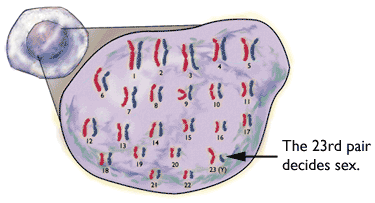
The chromosomes contain the hereditary material. They are found in nearly all cells. Almost every human cell has 46 chromosomes, arranged in 23 pairs. Each pair has one chromosome from the mother (red) and one chromosome from the father (blue). The 23rd pair decides the sex of the offspring.
Chromosomes and Reproduction
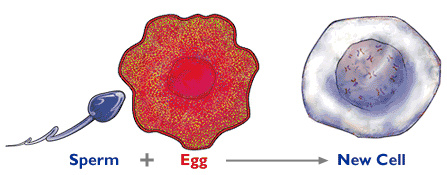
The first human cell is formed when the egg and sperm come together. The mother's egg carries 23 chromosomes, and the father's sperm carries 23 chromosomes. The result is a new cell with 46 chromosomes (23 pairs). This cell divides many times to form a baby.
How Sex is Decided
The 23rd pair of chromosomes decides the baby's sex. The mother's egg gives an X chromosome. The father's sperm can give an X or Y chromosome.
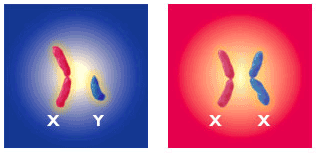
| Male Chromosomes: Males have an X and Y chromosome in the 23rd pair. | Female Chromosomes: Females have two X chromosomes in the 23rd pair. |
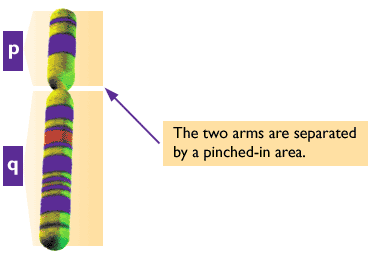
This is what a chromosome looks like up close. Remember, a chromosome holds your hereditary material. A chromosome has two portions called arms, which are separated by a pinched-in area. The short arm is called "p," and the long arm is called "q." The p and q arms are divided by a pinched-in area called the centromere. The bands correspond to different areas, or segments, of the chromosomes.
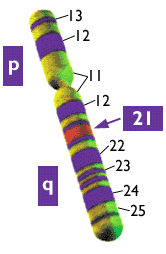
Segments of the chromosome are labeled with numbers. For example, one specific location on chromosome 17 is called "17q21." This is just like an address. It means you are looking at the long arm (q) of chromosome 17 at segment 21. This chromosome (number 17) and gene (BRCA1 on 17q21) are related to breast cancer.